Mira / Bio Age iOS App
One designer, zero engineers, three weekends
Mira is an iOS app that distills 11 Apple Watch signals into a single biological age, revealed once a week like a ritual instead of a feed. I designed the product, the interaction system, and the data models, then built it across three weekends by assembling and directing a team of 17 AI agents through Claude and Codex. No engineering team. No freelancers. One designer running an AI studio.
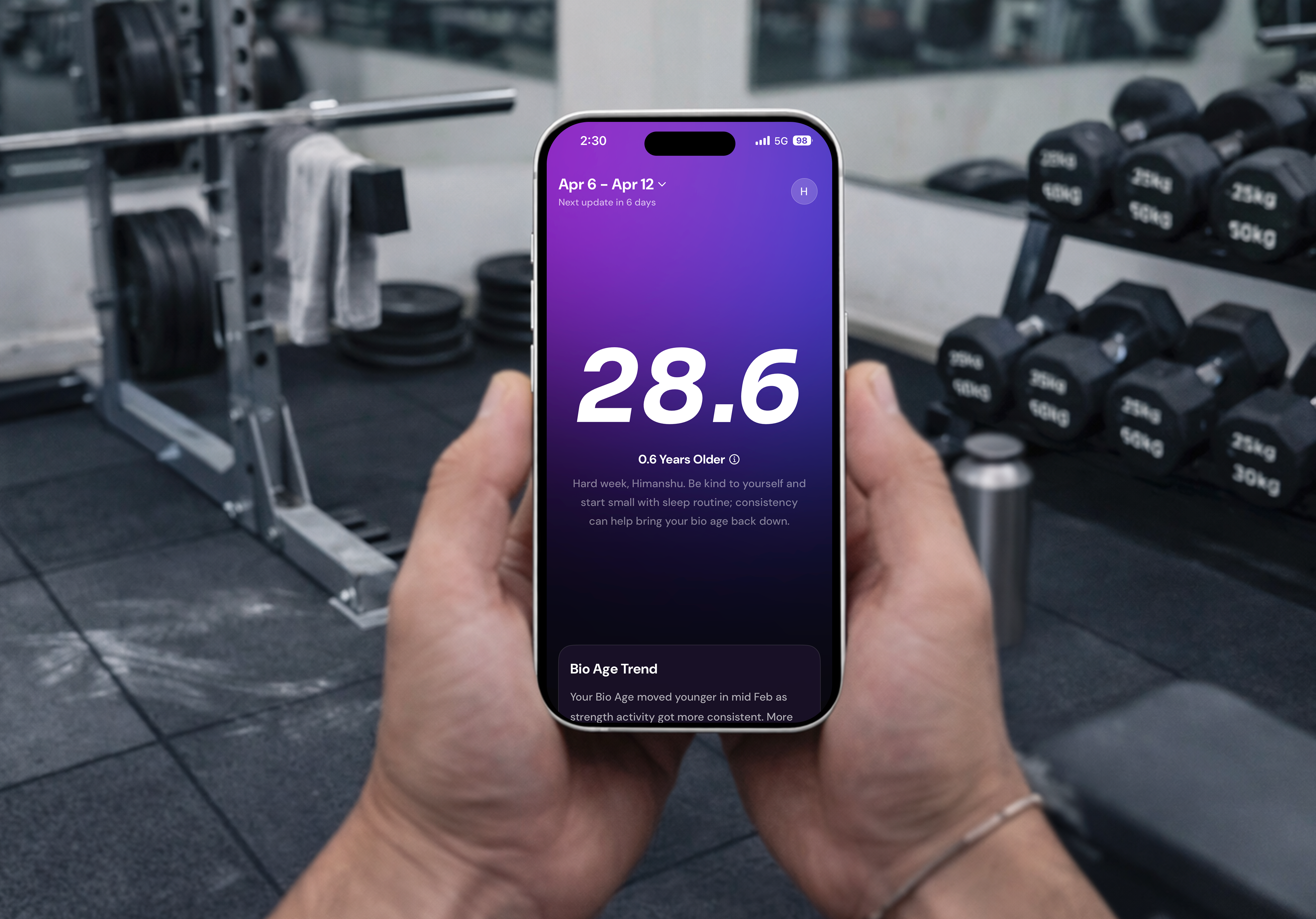
Every health app gives you more numbers. Mira gives you one. Your biological age, revealed every Sunday morning like a weekly letter from your body. I designed and built the entire thing, 18 calculation models, 11 screens, a cinematic reveal system, across three weekends by assembling a team of 17 AI agents and directing them like an engineering org.
Currently in public beta. App Store launch incoming.
The bet
Most fitness apps treat you like a day trader of your own body. Steps today. Heart rate now. Sleep last night. The data is noisy, the signals conflict, and nobody gets healthier from staring at dashboards.
Mira's bet: one number, once a week, with one thing to do about it is worth more than all the dashboards in the world.
The studio I built to build the app
I'm a designer. I'd never shipped a production iOS app. The traditional path: learn Swift for six months, or find an engineer and split equity. I did neither. I built an engineering org of 17 AI agents, each with a name, a domain, and a hard boundary around what it could and couldn't touch.
The roster
Not generic "code assistants." A named team with ownership rules:
The key insight: every agent knew what it owned and what it wasn't allowed to touch. When Copycat wanted friendlier language and Shield flagged a health claim, Boss surfaced the conflict to me with both positions. My job was the decision. Boss's job was making sure I had what I needed to make it well.
The documentation layer
The docs weren't afterthoughts. They were the management API. Structured markdown specs for every screen, every model, every edge case. An agent with a perfect spec produces perfect output. An agent with a vague brief produces garbage.
The quality of my documentation was the quality of my app.
Why this matters
I wasn't writing Swift. I was running a 17-agent studio. Three weekends, not three months.
This isn't a story about AI replacing designers or engineers. It's about what happens when a designer has a clear enough vision that the building becomes a direct translation, not an interpretation.
The product
11 signals in, 1 number out
Mira reads sleep duration, sleep consistency, steps, active days, heart rate zones, strength training, training load, VO2 max, resting heart rate, HRV, and lean body mass from Apple Watch. 18 models work together: adaptive hazard scoring, cardio overlap correction, staleness neutralization, on-device ML ranking. All on-device. No health data leaves the phone.
The confidence gate
New users don't have enough data for a real score. Instead of showing a shaky number, Mira shows a "Building your baseline" card with a progress bar. Bio Age unlocks at 75% confidence. That restraint costs first-day wow factor. It earns trust.
The Sunday reveal
Every Sunday at 10:00 AM, full-screen cinematic reveal. The number counts up over 3.2 seconds with haptic pulses. Stats fade in with staggered timing. If your bio age improved: confetti, color flash, heavy haptic hit. The reveal turns a data point into an event. Health behavior change starts with feeling something, not reading a chart.
The explainer
Biological age is something most people misinterpret. I explored four visual concepts. The "Time Decoupling" concept won: two parallel timelines showing calendar age marching steadily while bio age jumps around. Users got the core idea in under two seconds.
The action bridge
After the reveal, Mira generates a Weekly Focus Plan around your strongest headwind. A what-if engine shows honest confidence intervals for behavior changes. An on-device logistic ranker personalizes suggestions and suppresses bad recommendations during fatigue or low-data contexts.
The design system
Space Grotesk. 4pt grid. Age-band colors that tint the entire home screen: purple, blue, green, orange. Informational, not decorative. 44dp touch targets. Five animation curves collapsing to 10ms under Reduce Motion. Haptics per event type.
The lesson
I used to think the gap between designing a product and shipping a product was engineering talent. It's not. The gap is clarity. If you can spec it down to the staleness thresholds, the animation curves, and the edge cases, the building follows. The agents didn't replace an engineering team. They made me realize that what a great engineering team actually needs from a designer is exactly what these agents demanded: perfect specs, zero ambiguity, and decisions made before the build starts.
Three weekends. One designer. 17 AI agents. An app with 18 models and a cinematic reveal that makes people feel something about their health data for the first time.
Try Mira yourself
Your first Bio Age shows up instantly from last week's data. A fresh one arrives every Sunday. 11 Apple Watch signals, 18 scoring models, one number once a week. Everything runs on-device.